
A restricted or master key system proposal should explain more than the cost of cylinders, keys and installation.
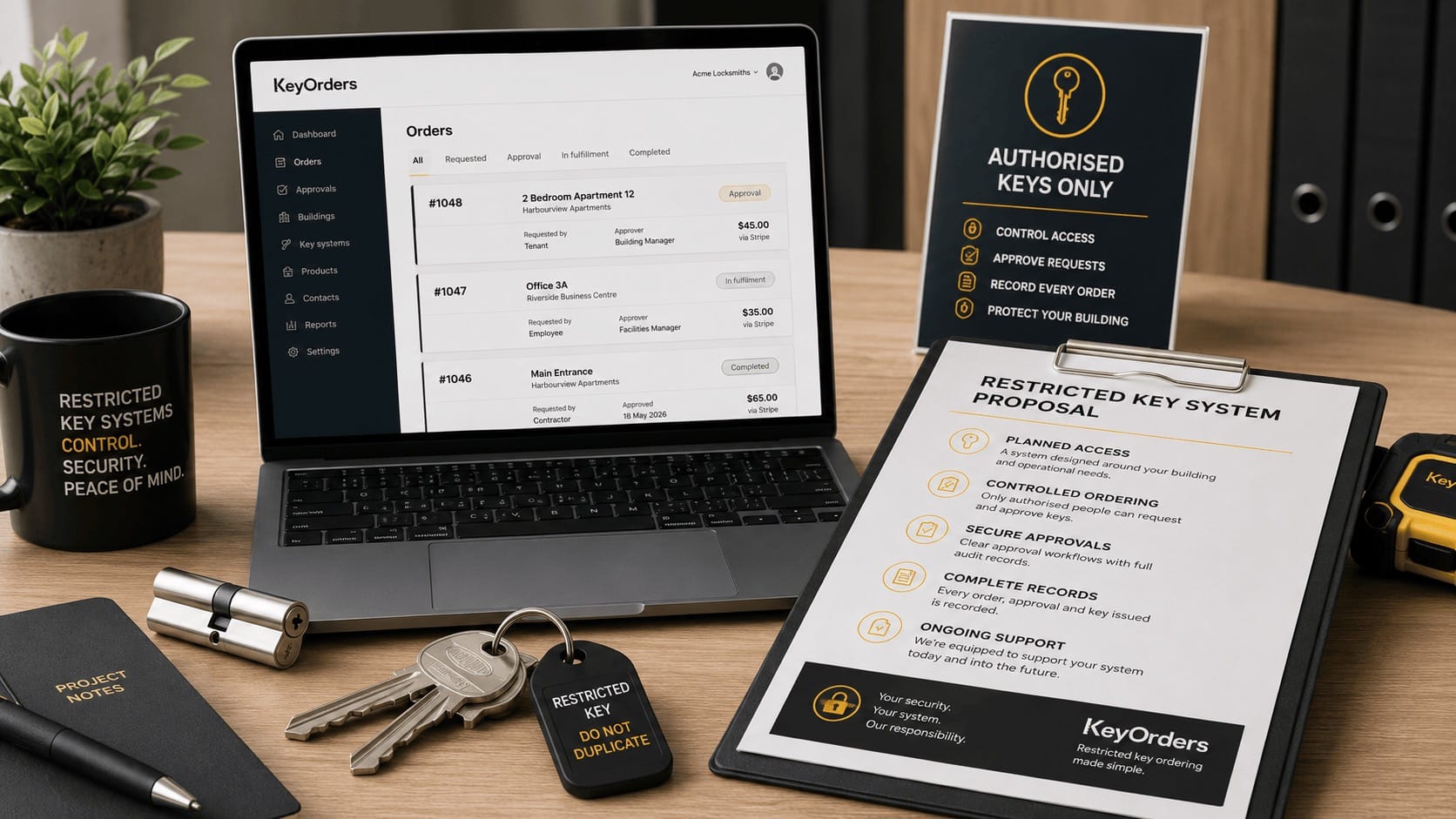
The physical system is central to the project, but it is only one part of what the customer is buying.
After installation, the locksmith may support the site for many years. Tenants, owners, staff and contractors will request additional keys. Authorised people will need to approve them. Payments, fulfilment and records will need to be managed.
A strong proposal therefore explains:
- what will be installed;
- how the system will operate after handover; and
- how the locksmith is equipped to support it over its working life.
Including the ongoing ordering and approval process makes the proposal more complete and helps distinguish a professionally managed system from a hardware-only quote.
Define the purpose of the system
Begin by explaining what the proposed restricted or master key system is intended to achieve.
Depending on the project, this may include:
- controlling who can receive additional keys
- reducing unauthorised duplication
- managing different access levels
- simplifying access across a building or site
- improving records of issued keys
- replacing an ageing or unsuitable system
- supporting future expansion
- establishing a consistent process across multiple areas
This gives the customer a clear reason for the recommended design and helps non-technical decision-makers understand the value of the proposal.
Avoid assuming that every building owner, committee member or facility manager already understands restricted key terminology.
Clearly define the project scope
Describe the buildings, doors and access areas covered by the proposal.
This may include:
- apartment or tenancy doors
- external entrances
- internal doors
- common areas
- offices
- plant rooms
- storage areas
- car parks
- gates
- service areas
- restricted-access rooms
Identify any exclusions, assumptions or areas requiring further inspection.
Clear scope reduces ambiguity, supports accurate comparison between quotes and makes later variations or expansions easier to manage.
Explain the proposed access structure
For a master key system, explain the general access hierarchy and how it supports the customer’s operational needs.
Relevant elements may include:
- individual keys
- keyed-alike groups
- master keys
- sub-master keys
- grand master keys
- common-area access
- service or contractor access
- restricted areas
- future expansion capacity
The proposal does not need to expose sensitive system detail unnecessarily. It should, however, give the customer enough information to understand how access will be organised and controlled.
Itemise the hardware and installation
The quote should clearly describe the physical work and products included.
Depending on the project, this may cover:
- cylinders and locks
- restricted key barrels
- initial keys
- associated door hardware
- installation labour
- removal of existing hardware
- testing and commissioning
- labelling or identification
- system documentation
- site attendance or travel
- disposal of replaced components
State relevant quantities, assumptions, exclusions and possible variation items.
This remains the core of the quote, but it should not be the end of the proposal.
Define system ownership and authority
Explain who will be recognised as the system owner or controlling organisation.
The proposal should establish:
- who controls authority for additional keys
- who may nominate or replace approvers
- who can request system changes
- which locksmith is authorised to produce keys
- whether and how the system is registered
- how authorised contact changes will be managed
- what happens when a building or property manager changes
This is especially important for apartment buildings and managed sites, where committee members, property managers, building managers and authorised signatories may change repeatedly.
A clear authority model reduces uncertainty after handover.
Include the future key ordering process
Do not leave future key orders as an undefined after-sales issue.
Explain how tenants, owners, employees, contractors or authorised representatives will request additional keys.
The proposal should cover:
- where orders will be submitted
- whether customers order directly from the locksmith
- how the correct building and key system are identified
- what information the requester must provide
- whether the process is available online
- what happens after submission
- whether collection and delivery are offered
- how customers receive progress updates
“Additional keys available on request” does not explain the actual service the customer will receive.
The ordering process may be used for years or decades. Present it as part of the system, not an administrative detail to be worked out later.
Describe the approval workflow
Restricted key control depends on a clear authority and approval process.
Explain:
- which requests require approval
- who is permitted to approve them
- how approvers are recorded
- how approval requests are delivered
- what information the approver can review
- how approvals and rejections are recorded
- how incomplete requests are handled
- how approvers are replaced when roles change
Avoid relying on a vague statement such as “approval will be obtained from the building manager”.
The proposal should show that the locksmith has a repeatable process for managing approval and retaining an appropriate order record.
For more detail, see why restricted keys need approval.
Explain how customer information will be handled
Restricted key orders can collect significant personal information, including:
- names
- residential or business addresses
- apartment, unit or lot numbers
- phone numbers
- email addresses
- key details
- approval information
- delivery details
- proof of authority
- payment information
Explain how customers will submit this information and how it will move through the ordering and approval process.
Email may be encrypted while travelling between mail systems, but ordinary email is generally not end-to-end encrypted. After delivery, messages and attachments can remain accessible in shared mailboxes, inboxes, archives, forwarded threads, synced mail applications and staff devices.
A stronger proposal can explain that the ordering process minimises unnecessary email copies and does not rely on forwarding completed forms containing extensive personal information.
Avoid asking customers to email payment card details or completed PDFs containing card numbers and security codes.
Define the payment process
Explain how payment will fit into the order workflow.
Depending on the locksmith and customer, this may include:
- online payment
- payment after approval
- payment links
- account or invoice orders
- payment on collection
- delivery charges
- administration or processing fees
- handling of declined or cancelled requests
Restricted key orders may not follow a standard retail checkout because approval or product confirmation may need to occur first.
The proposal should show that this has been considered and that payment will not depend on improvised manual handling.
For more detail, see online payments for restricted key orders.
Cover collection, delivery and fulfilment
Explain how completed keys or access devices will reach the customer.
The process may include:
- collection from the locksmith
- delivery to the customer
- delivery to a building or property office
- nominated collectors
- identity checks
- collection codes
- authority for another person to collect
- postage or courier charges
- records of collection or dispatch
This helps the customer understand the complete process and reduces uncertainty when future orders are placed.
Explain how order records will be maintained
The proposal should describe how future requests and decisions will be recorded.
Relevant records may include:
- requester details
- building and key-system details
- approval decisions
- payment status
- keys and quantities ordered
- fulfilment status
- collection or delivery
- internal notes
- completed order history
If information is divided between paper forms, inboxes, spreadsheets and accounting records, it can be difficult to establish what occurred later.
A central order history supports better service, clearer internal handover and more reliable record keeping.
Describe ongoing system support
Explain what support the locksmith will provide after installation.
This may include:
- processing additional key orders
- updating authorised approvers
- changing contact details
- maintaining ordering instructions
- updating prices
- adding buildings, doors or access groups
- supporting system expansion
- replacing lost or damaged keys
- handling management or ownership changes
This demonstrates that the locksmith is proposing a system they are prepared to support, not simply completing an installation.
Design the process to be commercially sustainable
Every restricted key project creates an ongoing service commitment for the locksmith.
Future requests must be received, checked, approved, paid for, fulfilled and recorded.
If each order depends on PDFs, shared inboxes, spreadsheets, manual payment follow-up and repeated status enquiries, the cost of supporting the system can grow steadily as more projects are installed.
That can make apparently valuable ongoing work less efficient than expected.
The proposal stage is the right time to establish a structured and repeatable process. A streamlined ordering workflow helps the locksmith:
- reduce routine administration
- avoid repeatedly re-entering information
- give staff a consistent process
- support more sites without proportionally increasing admin
- maintain service quality as order volume grows
- take on additional restricted key projects with greater confidence
This is an internal operational benefit, but it also strengthens the customer offer. A locksmith with a scalable process is better prepared to support the system over its full life.
Show how the future process will work
Where appropriate, include a simple workflow diagram, screenshot or explanation.
For example:
- the customer submits an order;
- the correct approver is notified;
- the decision is recorded;
- payment status is confirmed;
- the locksmith prepares the key;
- collection or delivery is completed; and
- the completed order remains available as a record.
This makes an otherwise abstract service easier for the customer to understand.
It also differentiates the proposal from a quote that lists hardware but says little about what happens after installation.
Present the ordering process as part of the offer
The proposal should make clear that the locksmith is providing a complete restricted key solution.
That offer can include:
- professionally designed hardware and access control
- installation and commissioning
- defined system ownership
- controlled approval
- direct customer ordering
- appropriate payment handling
- structured fulfilment
- ongoing records and support
This presents the locksmith as a long-term security partner rather than simply a supplier of cylinders and keys.
How KeyOrders strengthens the proposal
KeyOrders gives locksmiths a structured online ordering and approval system that can be included as part of the restricted key solution.
Customers order directly from the locksmith through a KeyOrders-powered site or page. The locksmith remains the supplier, controls the customer relationship and fulfils the order.
KeyOrders helps manage:
- structured customer requests
- building and key-system identification
- authorised approvals
- payment status
- fulfilment
- collection or delivery
- order records
- current pricing and ordering instructions
Including this capability in a proposal shows that the locksmith has considered the complete lifecycle of the system.
It also creates a more professional and supportable offer than relying on downloadable PDFs, basic online forms, shared inboxes and manual follow-up.
Restricted key proposal checklist
Before submitting the proposal, confirm that it covers:
- the purpose of the system
- project scope
- proposed access hierarchy
- hardware and installation
- initial key issue
- system ownership and authority
- future key ordering
- approval workflow
- payment process
- collection and delivery
- handling of customer information
- order records
- ongoing support
- future changes and expansion
The amount of detail will depend on the size and complexity of the project, but none of these areas should be overlooked.
Summary
A restricted key system proposal should cover more than locks, cylinders, keys and installation.
It should show how the locksmith will manage future orders, approvals, payments, fulfilment, records and ongoing support.
For the customer, this creates a more complete and professional offer.
For the locksmith, it establishes a repeatable process that can reduce long-term administration and make it easier to support more restricted key systems as the business grows.
The strongest proposal explains not only what will be installed, but how the complete system will be operated and supported throughout its life.